
Searching Cochran County Criminal Dockets
Cochran County offers no all-case search form. The District Clerk holds felony records for the 286th Judicial District Court. For Class A and B misdemeanor files, contact the County Clerk first. Class C and traffic cases sit with the countywide Justice Court. The municipal court that issued the citation may hold them instead. Sharing a courthouse does not mean sharing a docket. Court level matters from the start.
Have the cause number with its punctuation. Add the court name, filing year, and case category. No number? Give a narrow name and date range and ask about an index search. An office that lists email or fax details may still not accept requests through every channel. Confirm the method, price, and delivery form before sending personal data.
- Read the citation, notice, or filing stamp to identify the court.
- Contact the correct clerk with the cause number or a narrow search.
- Ask for the docket sheet, register of actions, judgment, or named order.
- Choose a plain or certified copy and obtain a current quote.
- Verify the newest hearing setting directly with the clerk.
Cochran Criminal Court Routes
Offense level controls which court holds the file. The 286th Judicial District Court, shared with Hockley County, has original felony jurisdiction. County misdemeanors generally reach the constitutional county court. The Cochran County Justice Court hears countywide Class C and traffic matters. Morton Municipal Court handles qualifying city ordinance and municipal Class C cases. Whiteface appeared in the 2023 official directory but not the 2025 edition. Callers should confirm its present operation.
| Case level | Court | Contact |
|---|---|---|
| Felony | 286th District | District Clerk |
| Class A or B | County Court | County Clerk |
| County Class C | Justice Court | JP office |
| City ordinance | Issuing city court | Municipal clerk |
Appeals from Cochran County trial courts go up to the Seventh Court of Appeals, following the rules that govern that step. The docket kept for the appeal is its own record, apart from the trial docket below.
Inside a Cochran County Criminal Docket
A docket sheet is a chronological index, not the whole prosecution file. It may identify the court, charging instrument, offense category, filings, settings, plea, orders, judgment, and costs. A public appeal notice may appear there too. It does not necessarily contain police reports, discovery, exhibits, recordings, or a prosecutor file. Read each line within that limit.
| Cause number | The exact court identifier; retain all punctuation and suffixes. |
|---|---|
| Charge | The filed allegation and level, not a finding of guilt. |
| Setting | An arraignment, pretrial, motion, plea, trial, or sentencing date. |
| Plea | The recorded response, which may precede final judgment. |
| Disposition | The resolution shown by the docket and signed order. |
| Restriction | A redaction or access limit where the index provides one. |
A dead end is not the end of the story. It can mean the wrong court, a spelling mismatch, an older file that was never digitized, restricted access, or delayed indexing. No result does not prove that no proceeding occurred.
Cochran Criminal Activity Snapshot
How busy were Cochran County's criminal dockets in FY 2024? The OCA annual reports give the numbers. Justice Court opened the year with 460 active criminal matters and took in 220 more. It disposed of 223. Another 28 went on the inactive list, so the court closed at 465 active. District Court ran a lighter criminal docket. It started at 50 active matters, added 20, and disposed of 38. The court ended with 32 active.
Treat these as activity counts. They are not unique people, convictions, crime rates, or a current backlog promise. Morton reported zero criminal activity in its municipal row, and Whiteface had no numeric activity, yet neither line proves that no citation or court existed.
How a Criminal Case Moves
A charging instrument starts the court record. Arraignment addresses the charge and plea procedure. Pretrial entries can record motions, waivers, and scheduling, and a plea hearing or trial may lead to judgment, with sentencing at that setting or later.
Docket flow: Filing → Arraignment → Pretrial → Plea or Trial → Disposition → Sentencing
Do not overread common entries. “Set for trial” means a trial was scheduled, not completed. “Motion filed” shows receipt, not a ruling. A later reset can replace the listed date. When the legal effect matters, obtain the signed order or judgment.
Note: A hearing setting is a planned event. Disposition records the resolution entered by the court.
Cochran Docket Terms in Context
Short docket entries invite overreading. Preserve the clerk’s exact words, and request the linked order when one exists.
- Reset
- A setting moved to another date; it does not dismiss the case.
- Dismissed
- Court action removed a charge or case; the signed order supplies the reason.
- Deferred disposition
- A statutory lower-court procedure available only when its terms and eligibility apply.
- Deferred adjudication
- A distinct procedure whose effects differ from conviction and nondisclosure.
- Disposed
- An activity category or completed court action that does not reveal the result alone.
Expunction and nondisclosure are different tools. Expunction concerns destruction or return of qualifying records, while nondisclosure limits public access in qualifying cases. An empty search should never be used to guess which rule applies.
Courts That Hold Criminal Dockets
Lisa Smith is listed as both County Clerk and District Clerk. Each office has separate custody. Their public contact is Room 102, 100 North Main Street, Morton, phone 806-266-5450. The district-court local line is 806-266-5412. Justice Court uses Room B-4 and 806-266-5302, and Morton Municipal Court is listed at 806-266-8850.
County and District Clerk
Room 102, 100 North Main Street
Morton, TX 79346
806-266-5450
Monday through Thursday, 8:00 a.m. to noon and 12:30 to 5:00 p.m.; Friday, 8:00 a.m. to 2:00 p.m.
Justice Court
Room B-4, 100 North Main Street
Morton, TX 79346
806-266-5302
Use for countywide Class C and traffic matters.
Before you pay a fee, find out which office holds the file. A single courthouse address does not mean the county, district, and justice records sit in one drawer.
No Single Cochran Case Portal
Texas has no single portal for all trial-court cases. The Texas Courts FAQ says so plainly. re:SearchTX pulls data from courts that take part, but its public interface returned an access-denied screen in September 2026, so Cochran coverage and public documents could not be checked there.
A few other state tools fill narrower needs. The OCA Citations and Notices search handles only citations and notices, with fields for text, name, cause number, court or county, and status. It stops short of a full criminal docket. eFileTexas, meanwhile, exists for submitting filings rather than public case lookup.
The official re:SearchTX entry itself records that September 2026 access state and what the service reports.
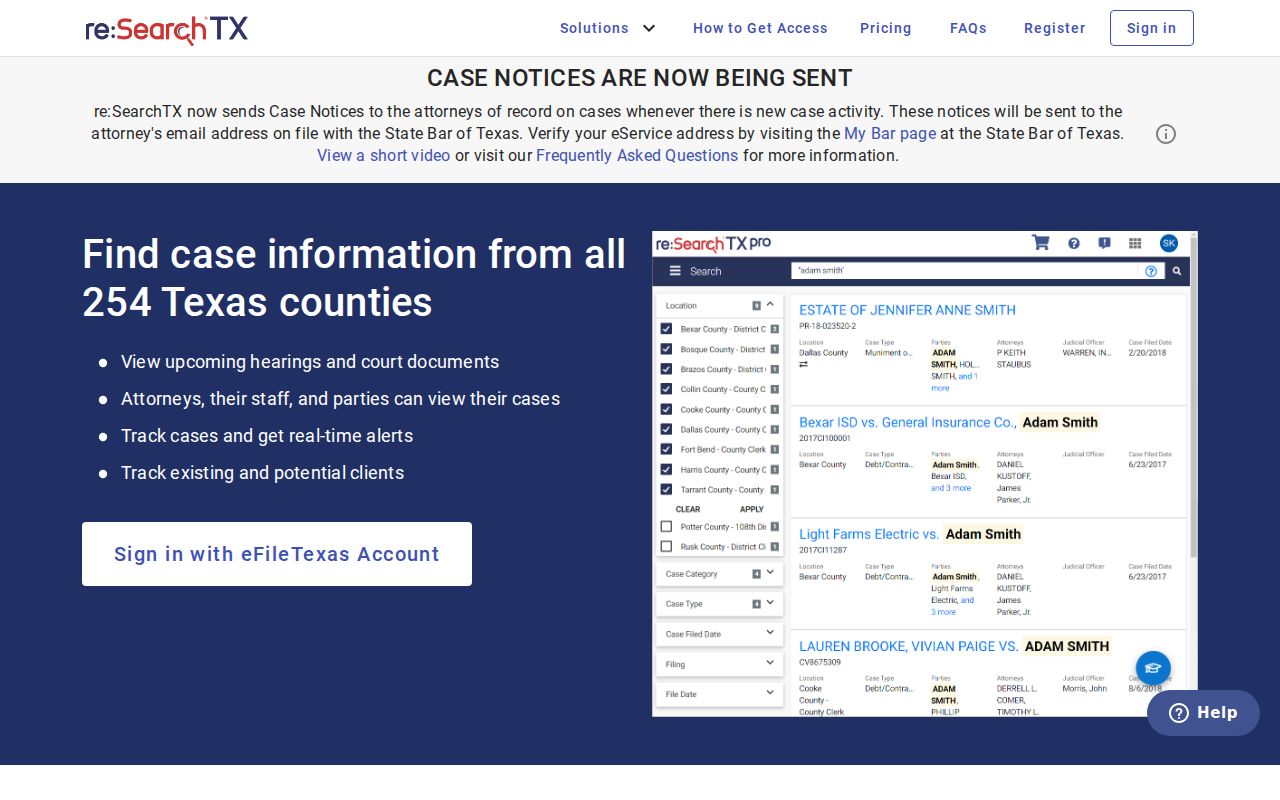
The image documents a portal gap, not the absence of any case or record.
Sealed Dockets and Public Access
Judicial case records in Texas do not follow the ordinary executive-agency request route. Government Code Section 552.0035 keeps judicial records under separate rules and common-law access instead. Rule 15 governs remote access to case records. Rule 12 reaches only covered judicial administrative records, not every criminal filing.
Key access rules
Texas Rule 12 governs covered judicial administrative records.
Rule 15 and Rule 76a guidance describes remote access and open-record principles.
Family Code Chapter 58 restricts juvenile records.
Not everything in a court docket is open to the public. Juvenile matters, mental-health files, child-protection cases, expunctions, nondisclosure orders, protective orders, and victim or witness details may be left out or blacked out. Ask the clerk what law blocks access and whether a public portion can be released on its own. Do not try to rebuild protected facts by piecing together other sources.
Verify Cochran Criminal Entries
Read any criminal docket entry with care. A charge is only an allegation until the record shows a final result, and a plea entry does not always equal the judgment. An FTA or FTP line just reports a failure to appear or pay. It is not a conviction. The court that issued the case controls it. DPS separately handles license administration after the court reports the matter.
Best next step: Ask the clerk to confirm the court, cause number, latest setting, status, and disposition, then request the signed order when the result matters.
Use the Cochran County case lookup for searching by name or cause number. It does not replace property records or commercial people-search results. For final confirmation, go to the clerk who keeps the original docket.
Cochran Clerk Search Follow-Up
Once a clerk gives you the right criminal cause number, ask about the Cochran County docket. Ask which parts are index-only. Ask which public documents can be copied. Request one item at a time. Name the docket sheet, the charging instrument, a signed judgment, or a notice of appeal. Say whether you need certification, too. A list of entry titles is not the text of each filing. Keep the two distinct.
Older records may sit in paper files only. The clerk posts no public terminal. Call before you travel. Ask whether an index can be searched at the counter, and whether document images can be viewed there. Mail, fax, email, and pickup may work for some requests. Let the clerk approve the channel and the payment method first. The district fee schedule dates to 2015. It lists a five-dollar party search plus per-page copy items, so confirm those figures before paying. The statewide clerk manual sets out separate certification and page charges. Those can vary by copy format.